
The plant require a proportional combination of macronutrients and micronutrients. The utility of these nutrients are discussed below with the sign of deficiency syndromes in a plant. To know how to use click here.
Macronutrients:
Nitrogen (N):
Used in larger quantities than any other mineral nutrient. Most frequently deficient for normal growth of non-legumes
Forms taken up by plants: NO3– NH4+
Function in plants:
- It is part of the amino acids which make up proteins
- It is part of the chlorophyll molecule
Deficiency symptoms:
- Plants become stunted and/or become yellow on the older leaves
- N is mobile in the plant so new leaves may remain green
- Excess N may delay maturity
- Cause excess growth and little fruiting on melons and tomatoes. Excessive succulence may make a plant more susceptible to disease or insect attack.
Phosphorus (P):
Forms taken up by plants: H2PO4– primary orthophosphate, H2PO4— secondary orthophosphate
Function in plants:
- a part of the protein molecule
- Necessary for transfer of energy during metabolic processes (ATP)
- Hastens maturity, promotes good root development, improves growth and cold tolerance, and improves seedling vigour, important in seed and fruit formation.
Deficiency symptoms:
- Dark green colour
- Purple cast in corn, lower leaves first because p is mobile.
- Delay in maturity
- Failure of seed to form
Potassium (K):
It is used in larger amounts than any other element except N. May have “luxury consumption” plants take up more than is needed. K is not a part of any structural component of the plant. Located in the cell sap as an inorganic salt.
Forms taken up by plants: K+
Function in plants:
- It is a catalyst in many reactions; carbohydrate, starch and N metabolism
- Activation of enzymes involved in photosynthesis, and protein and carbohydrate metabolism
- Adjustment of stomatal movement and water relations
- Helps disease resistance
- Increases quality of fruits and vegetables
- Tips and margins of leaves turn brown. K is mobile so this occurs first on lower leaves.
Deficiency symptoms:
- Weakening of straw in grain crops (lodging)
- K is important in preventing non-protein N from accumulating in plants. When this occurs in forages it may be injurious to animals
Micronutrients:
Calcium (Ca):
Forms taken up by plants: Ca++
Function in plants:
- Calcium gives strength to cell walls
- Needed for peg development in peanuts
- Plant root and tip elongation
Deficiency symptoms:
- Ca is immobile so new growth is affected
- Failure of terminal buds to develop
- Symptoms are not usually seen under field conditions because other problems caused by acidity of soil will generally become limiting factors before Ca. That is, liming prevents Ca deficiency from occurring.
- Blossom end rot of tomatoes is an exception to this generalization
Magnesium (Mg):
Forms taken up by plants: Mg++
Function in plants:
- A part of the chlorophyll molecule, essential in photosynthesis
- Related to phosphorus metabolism
- Large quantities found in seed
Deficiency symptoms:
- Mg is mobile so symptoms occur first in old leaves.
- Interveinal chlorosis. A whitish or yellowish striping effect on grasses.
- Tobacco – referred to as sand drowning.
Sulphur(S):
Forms taken up by plants: sulphate some SO4-2 (Sulphur dioxide through leaves).
Function in plants:
- A constituent of 3 of the 21 amino acids which form protein cystine, cysteine, and methionine
- Present in the organic compounds that give the characteristic odours of onion, garlic, and mustard.
Deficiency symptoms:
- Uniformly chlorate plants which are stunted and spindly. Similar to N deficiency symptoms. It is less mobile than N so deficiency may be more apparent on younger leaves.
Manganese (Mn):
Forms taken up by plants: Mn++, Mn+++
Function in plants:
- Can be absorbed through the leaves. Required in small quantities – large amounts are toxic (acid soils)
- Activation of enzyme systems
- Chlorophyll synthesis
Deficiency symptoms:
- Mn is immobile – The upper leaves develop yellow streaks.
Iron (Fe):
Forms taken up by plants: Fe++ (ferrous form) Fe+++ (ferric form), Can be taken up by the leaves
Function in plants:
- A catalyst in the production of chlorophyll
- Enzyme systems
- Occur on high ph soils or certain plants
- Centipede, azaleas.
Deficiency symptoms:
- Immobile so deficiency symptoms occur on young leaves. Interveinal chlorosis. Leaves may turn completely white
Copper (Cu):
Forms taken up by plants: Cu+2 can be absorbed through leaves. Very toxic if too much applied.
Function in plants:
- Copper is a catalyst in chlorophyll formation
Deficiency symptoms:
- Immobile so upper leaves affected
- Corn youngest leaves are yellow and stunted
- Vegetables – plants wilt and develop a bluish green cast.
Zinc (Zn):
Forms taken up by plants: Zn+++ can be taken up through leaves. Toxic except in small quantities
Function in plants:
- Activator of enzyme systems
- Deficiency symptoms:
- Occurs on younger leaves (immobile)
- Interveinal chlorosis followed by reduction in rate of shoot growth and shortening of internodes (rosetting)
Boron (B):
Forms taken up by plants: H3BO3 can be taken up through leaves
Function in plants:
- Can be very toxic if applied to some crops at rates not harmful to others. Deficiency occurs frequently on alfalfa.
- Germination of pollen grains and growth of pollen tubes
Deficiency symptoms:
Immobile upper leaves affected. Growth of terminal bud stops
Molybdenum (Mo):
Forms taken up by plants: Mo required in smallest amounts of any mineral nutrient. Excess may be toxic to grazing animals. Moo4
Function in plants:
- It is needed for conversion of NO3- to NH4+ in the plant
- Required by rhizobia for N fixation in the nodules of legumes
Deficiency symptoms:
- Interveinal chlorosis
- With legumes it appears as N deficiency (that’s what it is
Chloride (Cl):
Forms taken up by plants: Cl-
Function in plants:
- Photosynthetic reactions
- Reduced root growth in nutrient cultures.
Deficiency symptoms:
- Excessive quantities has a detrimental effect on quality of potatoes and tobacco storage quality of potatoes reduced. Smoking quality of tobacco lowered.
Silicon:
Needed in small quantities by rhizobia for fixation of N in association with legumes. 8 oz/acre on clover gave response essential in formation of vitamin B-12.
Shown to be essential for a green algae
Not shown to be essential for higher plants but growth increases were shown with asparagus, rice, lettuce, barley, corn.
Functions: may be essential for carbohydrate metabolism in some plants. May substitute for potassium
Increased growth of rice in nutrient cultures. Function unknown.
In short we see:
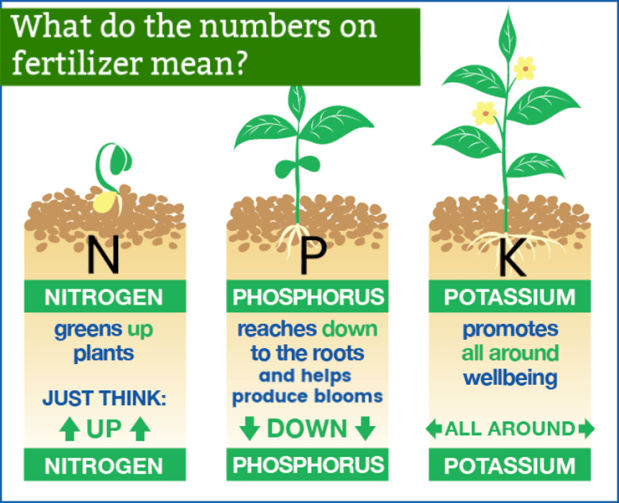
N – Synthesis of proteins and part of chlorophyll molecule
P – Energy transfer
K – Carbohydrate metabolism, water relations
Mg – Chlorophyll molecule
S – Proteins
Ca – Strength of cell wall
Micronutrients – Enzyme activation
Hope you will benefit from this for any query comment here. And Follow to stay updated about new tips for your garden.
 Green Gardens